Wednesday, July 24, 2013

Environmentality, 24th July 2013

 Hello Environmentality listeners,

This week our friend, Robert Bender, returned to talk all about fungi. Strange but true fact, the fungus is the largest living organism on Earth!

Jaime, Robert and Smokey at the studio

Fungi are commonly classified as a plant, however as Robert explains, fungi is not a plant as it does not photosynthesize. Rather fungi is classified as a separate kingdom. Most of the fungi living matter can be found underground. Mushrooms are the ‘fruit’ of fungi and are akin to pimples on us! The role of the mushroom is to spread spores through air or water. The body of the fungi is a thin material that propagates through the soil, logs and living wood. Fungi are made up of 96% of water; they will only pop out during wet periods.

Fungi has been around for the past 400-450 million years, its essential function is to rot wood, extracting nutrients from dead or living wood. Fungi has a symbiotic relationship with vascular plants such as trees, grasses and herbs. Vascular plants do not extract nitrogen from the ground well; fungi do not have the ability to make their own foods. Vascular plants and fungi partner together that is mutually beneficial to both, vascular plants obtain their nitrogen from fungi in exchange from nutrients extracted from the vascular plants. About 97% of Australian vascular plants use fungi to absorb nitrogen.   

Previously we didn’t know very much about Australian fungi, it was estimated that there are 10,000 species of fungi. The Fungimap project started to map the different species of fungus. Starting with 100 species 15 years ago, there has been 10,000 citing of fungi by volunteers. Volunteers have taken photos of fungi and sent them into fungimap. Fungimap 2 with 100 species have started, to learn about mapping fungi in your area, view their website.   


If you plan on going on a mushroom hunt, field mushrooms are edible. However the Yellow Strainer is a native species that looks just like a field mushroom except when it is bruised, it turns sulfuric yellow. Death Caps also look similar to field mushrooms that are commonly found in domestic gardens. Mushrooms have been known to cause serious illness and even death, thus before eating wild mushrooms, make sure you know it’s not poisonous.  

The Yellow Strainer, courtesy of ausphotography.net.au
Fungi come into all different shapes, colours and sizes. To learn more about fungi and truffles (yes truffles is a fungi!), look up Fungi down under and tune into the podcast

Tracks played today:
Stereo Love
Desafinado
Lisa Miller- It will never happen again
Get back again- Kutcha Edwards
Battleships- Bernard Fanning. 

Wednesday, July 10, 2013

Environmentality, 10th July 2013

Hello Environmentality listeners,

Jaime, Ahmed and Fola chatted to Cintia Gonzalez about upcycling. Cintia comes from a crafty family and has learnt how to sew and knit from her mother. Cintia has been blogging for the past 5 years.

Courtesy of  mypoppet.com.au

Upcycling is when something new is made from something old or something that might have been thrown away. Although its roots may have come from thriftiness, upcycling not only benefits your hip pocket but also the environment. By choosing to reuse, we are diverting waste from landfill and saving the water, energy and resources that would have gone into making new products.  

Upcycling is also great to develop and learn new skills. By creating your own products, you will be more likely to appreciate the time and skill required to make the product, hence more likely to value it and less likely to throw it away. You don’t need to have formal training to start, just interest! Start small and build up your skill set with each project. A good project to start with is decorating old jars and shoe boxes for storing things. Pinterest is great if you’re stuck for ideas as we were! You-tube is also fantastic if you’re looking to up-skill.

One of Cintia’s projects is a braided carpet made from 13 old t-shirts that have been worn out. Cut into strips, the t-shirts were braided and sew together. One of Cintia’s better known projects is the cross stitch chair that was fixed and covered in wool cross stitch pattern. The chair has been featured in international design websites and magazines.

Braided T-Shirt Rug, Courtesy of mypoppet.com.au

For other projects and photo step to step guides, check out Cintia’s blog. You can also follow Cintia on twitter @mypoppetshop and instagram  

The joy Cintia attains from creating her own products is infectious and Cintia’s enthusiasm can clearly be shown through her work. To hear more about Cintia’s blog, her other projects, yoghurt container curtains and catch some of Cintia’s enthusiasm, listen to the podcast.

For more information about the Broadmeadows Bicycle Hub, click on Banksia Garden’s website.

The Environmental champions monthly social catch up meets the second Wednesday of every month from 6:30pm till 9pm at the Hume Global Learning Centre. For bookings and other events, go to http://www.livegreenhume.eventbrite.com.au or call 9205 2310 

Tracks played:
What are friends for- Gabriel Lynch
Waking up is hard to do- Go You Huskies
Lights down- Go You Huskies

Wednesday, July 3, 2013

Environmentality, 3rd July 2013

Hello Environmentality listeners,

Jaime, Fola, Ahmed and Smokey spoke to Beth Askham from the Alternative Technology Association (ATA) about the September issue of ReNew magazine. The ATA is member organization which provides information and resources to member about how to improve the sustainability of their homes.


Courtesy of the ATA

Learn about how to make your own biochar from a modified drum in the latest issue. Biochar is clean charcoal made from burning organic matter through pyrolysis; the organic matter is burnt cleanly so there is no smoke produced. Biochar is great for the soil nutrients and for holding carbon in the soil.

Beth also talks about some of the appliances that can be used to monitor the energy use at home. Monitoring the energy use is a good way to understand where and when you’re using the most amount of energy. Some of these appliances tap into the smart meters. For more a guide to smart meters, you can go to the ATA website.

The recent Electric Vehicle Expo brought together electrical vehicles such as bikes, skates and cars. Although several years ago the only way to have an electric car was to make your own, it has now become more affordable. Despite Victoria coal driven electricity, electric cars can still be environmental friendly with solar PV roofs, solar recharge station such as at CERES and high levels of efficiency.

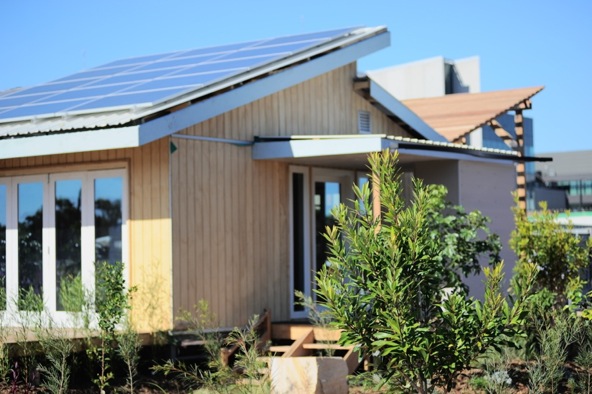
The University of Wollongong has retrofitted a fibro shack and entered in the Solar Decathlon competition. Using sustainable technology and green design, the house has been designed to be energy neutral; creating all the energy the house needs. To learn more about the project, visit their website:  http://www.illawarraflame.com.au/
                                                                           
Courtesy of UOW’s Illawarra Flame

To learn more about the petition set up government grants to help start community owned energy projects such as energy and solar go to the website www.fundcommunityenergy.org  

The ATA has also started selling accredited green power through the Community Climate Chest. We can now buy green power from community groups and NGOS rather than the retailers. 

We then further chatted about Soccer, politics, the East-West Tunnel, and the carbon tax and emissions trading scheme. Tune into the podcast to hear more about the ATA and Smokey’s views the East-West tunnel and the carbon tax.      

Tracks played:
Wolf Mother- White Unicorn
The Pixies- Here Comes Your Man
Tim Buckley- Chase the Blues Away

Wednesday, June 26, 2013

Environmentality, 26th June 2013

Hello Environmentality listeners,

After some technical difficulties, we finally got into contact with Cam Walker from Friends of the Earth. Friends of the Earth is a membership based organization that engages in environmental issues. Friends of the Earth integrate human rights with environmental issue to try to achieve good outcomes for both the community and environment. Active around the world, Friends of the earth has groups in more than 70 countries. We chatted to Cam about climate change refugees, the east-west tunnel and wind power politics.

Courtesy of Friends of the Earth 


The current UN convention for refugee classifies refugees as people affected by War. However the Friends of the Earth believe that there is another category of refugees the convention overlooks; people forced from their homes due to climate change. Many of the climate change refugee comes from low lying countries and islands that are particular vulnerable to any changes to their climate due to their on agriculture and fishing industries. Furthermore, many of these countries also do not have the resources to adapt to the impacts of climate change. “They are in the front line"; it will be the some of the poorest people in the world that will be greatly impacted. The majority of global warming created by rich nations, and as such it is this carbon debt that is causing the problem. Hence it is reasonable that developed nations accept their responsibilities and start planning for climate change refugees. Rather than rewriting the current UN refugee convention, Cam highlights that a new agreement should be created.

With the Chinese shift towards renewable energies and Obama’s recent statement about climate change, is it possible that there is a global shift towards global collaborative climate change action? It may be too early to say at the moment, but signs are definitely hopeful. With China and the US taking a stronger position on climate change, is it likely that other nations will now be willing to take action?

We quickly also chatted to Cam about the east-west tunnel. Money should be invested into improving public transport and supporting people reliance on public transport. To read Kenneth Davidson’s article that was mentioned on the show, click here.  Cam shares Environmentalities sentiment about the lack of government supporting wind power; the current state government’s laws excluding wind energy and preference for coal over renewable energies.

Don't forget to listen to the podcast!

Some Tracks played
The Rubens- Don’t Ever Want to be Found
David Bridie- Wake
Mark Moroney- Circles
Major Chord- Everything is Everything

Cat Empire- Steal the light   

Wednesday, June 19, 2013

Environmentality, 19th June 2013

Hello Environmentality listeners,

Our resident gardening expert, Jodie, returned this week after a long absence. It was certainty good to have Jodie back! Ahmed, Jaime and Fola chatted to Jodie about what we can do in the garden during winter.

Just because it is cold outside doesn’t mean we shouldn’t be out in the garden, there’s still plenty to do. It’s bare rooted season so we should be planting things like potatoes, garlic, root vegetables, turnips, parsnips, cabbage, Asian greens and peas. Jodie’s recommendation if you’re confused, “think soups”. Winter time is also a great time to be preparing the ground with lots of organic matter, putting down mulch around the vegie patch and fruit trees.   

Some councils also provide free mulching. More about Hume City Council’s free mulch day can be found here.

Thinking about starting a new garden? Jodie suggests winter is the good time to start; it’s cool and not too hot to be working outside. Now is also a good time for green manures (putting organic matter into the soil). You can go to your local farm supplies and get some broad beans. Once germinated, once they are knee height you can turn it into the soil to be broken down for spring.

First step for first time gardeners, if you’re unsure about your soil, check the pH levels. pH kits can be found at your local garden stores or you can make your own from red cabbage! And don’t be afraid of clay, clay is full of minerals that are fantastic for the soil. To break up the clay, composting and cultivating with green matter.

A rainy, there’s still lots we can do. Think outside the box! Here’s Jodie’s list:
  • Tool maintenance: sharpening, cleaning and oiling
  • Process your seed: sorting and milling
  • Work on your garden diary: take notes on your garden every now and then
  • Stare out the window: reflect on your garden

Jodie’s advice if you’re busy? Everyone can do 15 mins to 30 mins in the garden every day.

To hear all of Jodie’s great advice, don’t forget to listento the podcast!

Tracks Played:
Smooth Criminal - Alien Ant Farm
Tell me how it ends- Bernard Fanning
Departures- Bernard Fanning
Circles- Mark Moroney  

Tuesday, June 18, 2013

Environmentality, 12 June 2013

Hello Environmentality listeners,

One thing we had never done on Environmentality was a pre-recorded interview. On this day Fola and Jaime ticked that milestone off our list, it was a very decent effort despite Jaime's initial (and unsuccessful) attempts to pretend the interview was live.

The main feature of this pre-recorded segment was a very interesting chat about Geothermal Power with Michael O'Connell, an engineer, lecturer and environmental educator who volunteers with the Alternative Technology Association’s International Projects Group.

Michael O'Connell, courtesy of Leader Newspapers
Michael proved to be a knowledgeable and engaging guest, so it did not surprise us when we learnt that he also hosts a gardening show on WGRN and has his own blog, Six Gorillas.

Unfortunately on the day we were experiencing some technical difficulties and as you will be able to notice if you listen to the podcast, the sound quality is less than ideal. Despite this, I still think it's worth listening to what Michael had to say!

Listen to the podcast!

Wednesday, June 5, 2013

Environmentality, 5 June 2013

Hello Environmentality listeners,

Today we had another pleasant conversation with an old friend of Environmentality, John Merory. John is a neurologist and a committed environmentalist and he agreed to spend some time with us talking about sustainability and transport.

From the conversation it was clear that John has spent a huge amount of time thinking about this issue, and thanks to this we managed to cover quite a lot of ground. Some of the topics discussed included the environmental and health impacts of fossil fuels based transport, pros and cons of helmet laws, the controversial East-West road link or the potential introduction of a congestion tax in Melbourne.

John Merory - courtesy of the Heidelberg Leader newspaper
As people can imagine, John is a passionate advocate of the humble bicycle (as he put it, by far the most energy efficient mode of transport ever invented)  as a mode of transport, and we also talked about the need to provide infrastructure to support increasing bicycle usage (green ways, more train services).

One of the things I will take away from our conversation was John's explanation about how inefficient conventional cars are (in his words, only about 1% of the fuel is used to transport the person travelling when one person is in the car), and his clear account of the health impacts of this mode of transport through  reduction of physical ability.

The tracks we heard were:

Black boy / The Medics and Bunna Lawrie
How to see through fog / The Drones
Quasimodo's dream / Gotye and Perfect Tripod
A man like that / The Transatlantics

I hope this is enough for you to decide to listen to the podcast!
Related Posts Plugin for WordPress, Blogger...